what rank do you have to be to play competitive cs go

CS:Go Ranks and How do They Piece of work

As in most online games, Counter-Strike with Global Offensive also has a ranking organisation – this is how it is determined which skill rating the player is in. If you desire to work your way up here, y'all should understand the different ranks and the system behind them.
When you get-go CS:Go for the first time, y'all immediately notice the lack of a rank bluecoat next to the thespian name. Because this bluecoat is earned in CS:GO only by participating in games in competitive mode or, for short, in "Ranked". However, this must first be unlocked, with not-competitive modes such as casual, deathmatch, etc. Equally before long as the player has reached profile rank 2, he can start immediately in the ranked.

In competitive way, ten victories must at present be achieved – sounds like shooting fish in a barrel, but unfortunately it is not. Because in that location are the other players who are matched together by an algorithm. From accented newbies to experienced players, everything can exist included. And even if yous finally manage to win a few matches, you can only achieve ii victories per day, so that the desired rank is achieved in the best example after five days.
The long-awaited tenth victory finally brings outset place on the global offensive. Depending on how the actor performed personally and how long information technology took them to win ten wins, the profile is assigned one of the 18 ranks of the game.

CS:GO Ranks/Skill Groups
If you take won at least ten matchmaking games, the skill group you are in will now exist displayed in the main menu. Depending on how well you lot play, you will be assigned to a certain group and then that the matchmaking organisation finds the nearly suitable opponents. Nevertheless, this only applies to the Classic Competitive Way, all other game modes are contained of this ranking system.
If yous get better, you naturally rise over fourth dimension and face ever stronger opponents. But how many groups are in that location actually? And how large is the skill group you are currently in? Here is the list with all CS:Become ranks:
- Silver I
- Silver Two
- Silver III
- Silver IV
- Silver Elite
- Silver Elite Master
- Gilded Nova I.
- Gold Nova II
- Gold Nova Three
- Gold Nova Primary
- Principal Guardian I
- Master Guardian 2
- Master Guardian Elite
- Distinguished Principal Guardian
- Legendary Eagle
- Legendary Hawkeye Master
- Supreme Master First Class
- The Global Elite
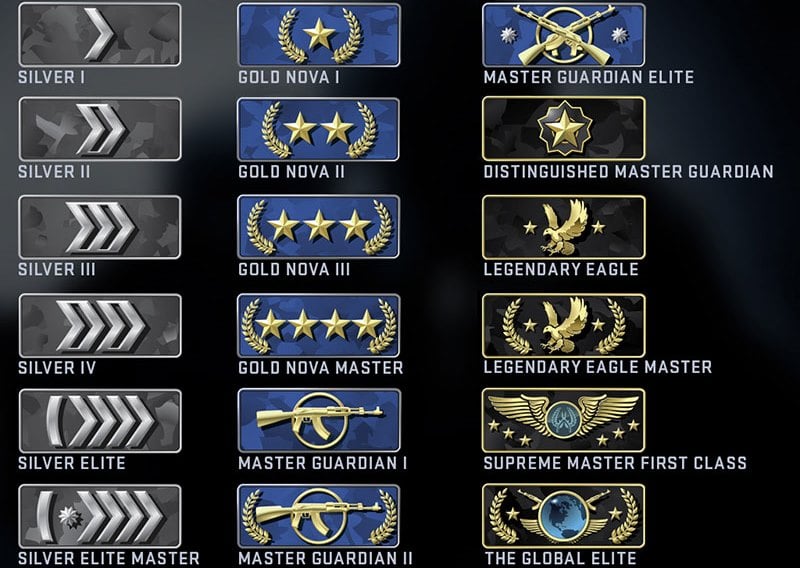
Unless you're a natural in Counter-Strike, you'll likely get ranked in the silver region starting time. Merely be careful, this ranking category is teeming with other beginners, but also so-chosen grievers who want to spoil the fun of others by sticking to the rules, merely playing more obstructive than target-oriented. There are also many smurf accounts, i.e. secondary profiles of players whose main account is ranked much higher. These are either used to be able to play with poorly ranked friends or simply to take fun without having to brand an endeavor.
Getting out of the silver ranks is accordingly a tough chore that many have failed to achieve. But don't worry, with the correct attitude and an understanding of the ranking organisation it is quite possible to piece of work your way up to the gold nova realms and even beyond.
Placement in a skill group
To get a rank, you must first win 10 Archetype Competitive Matches. However, you tin have a maximum of 2 victories per day during this time. Then you get a cooldown and cannot play competitive matches over again until the adjacent day.
If you have won ten matches, you are classified in a skill group. From then on you can play an unlimited number of matches.
Note: Before y'all can even use competitive matchmaking, you must have reached at to the lowest degree level 2 in the Contour Ranks.
How does the CS:Become ranking system piece of work?
On the Internet you can detect a lot of explanations well-nigh how the ranking system in CS:GO supposedly works. Simply the fact is that a lot of it is pure speculation and some of it is just wrong. The affair is, Valve itself has given extremely little information about how the system works.
However, Vitaliy Genkin made a few statements about how the ranking system works in a argument on Reddit. Although information technology does not reveal any details, it describes the idea on which the arrangement is based.
The ranking system in CS:Become is based on the Glicko 2 system or has ideas from it as a ground. Such rating systems are used, among other things, in chess to indicate the skill level of players. The Glicko-two rating arrangement works like the Elo system with a rating number for players, but contains two additional variables. The variable RD ("ratings divergence") indicates how much a player'south rating deviates from his bodily force. If you play a lot, you accept a depression RD value because the rating number becomes more accurate with each match. If you don't play, the RD value increases slowly simply steadily. So in that location is the "rating volatility", which is represented by the Greek letter sigma. For the sake of simplicity, nosotros volition refer to them as RV at this signal. This variable indicates how consistently a player plays. The more than consistently you play, the lower the RV value.
These ii variables ensure that not only scores are compared with ane some other. Instead, it increases the reliability of the assessment and takes fluctuations into account. This is useful, for example, when playing confronting players who have not been active for a long fourth dimension and who are therefore hard to assess past the system.
Valve took the Glicko-2 organisation equally the basis for the CS:GO ranking, but adjusted it over time so that it meliorate suits the game. After all, CS:GO has a unlike gameplay and dissimilar focus than, for example, chess. How exactly these adjustments expect is unknown.
CS:GO is a squad game, then the decisive factor is certainly whether you win or lose a friction match. However, individual functioning also counts to a certain extent. However, it remains uncertain whether this will be linked to the K/D ratio, the MVPs or other factors. A broad multifariousness of statements about this are circulating on the Net, merely yous should not really rely on any of them. Most of it is pure speculation. You should just try to play as well every bit you tin can, fifty-fifty when yous are losing.
Based on the ranks of the private players, the ranking system always predicts how the friction match will end in advance. At the end, the actual result is compared with the forecast. So it doesn't matter if you lose to improve players – the organization assumed that is how the lucifer will end.
Why doesn't Valve reveal any details about how the ranks are calculated?
One of the nearly obvious reasons is that Valve wants to avert players but looking to rise in rank and forgetting about squad play. However, the so-chosen "boosting", ie the dragging of worse players to college ranks, is a real nuisance. If all the details nearly the functioning of the ranking system were known, then this could possibly be exploited. The ranks would and so lose their meaningfulness and the whole organisation would be pointless.
When do you get an uprank or a downrank?
It all depends on what kind of opponents you are presented with and how y'all fight against them. To go an uprank, you lot should win more against equally strong and stronger opponents. If y'all lose more oft to players who have a lower rank than yourself, then you go downranked.
Distribution of players to the ranks
The skill grouping reflects where you stand up compared to other players. The distribution of the players on the ranks graphically shows a bell curve. In a presentation on music in Valve games, composer Mike Morasky revealed that around 50% of players were Gold Nova three or lower, and effectually 95% of players were Distinguished Chief Guardian or lower. This statement also coincides with the thought of a bong curve. We take shown this normal distribution as a bar chart.
Even if there is no other official information on the distribution of the players via the ranks, we tin can presume that this graph is very close to the actual distribution. The ranks Gold Nova 3 and Gold Nova Principal thus grade the golden hateful and comprise around a quarter of all players.
The following list expresses the distribution once more in raw numbers. The percentages behind the ranks point what per centum of all players are in this rank. Although the figures are only estimates based on the assumption of a normal distribution, they can certainly be used equally a guide.
- Silver 1: 0.43%
- Silver two: 0.56%
- Argent 3: one.45%
- Silvery 4: 2.51%
- Silvery Elite: 4.39%
- Silver Elite Master: 7.01%
- Gold Nova i: 9.11 %
- Gold Nova 2: 11.61%
- Golden Nova 3: 12.93%
- Gold Nova Master: 12.93%
- Principal Guardian one: 11.61%
- Master Guardian ii: nine.11%
- Master Guardian Aristocracy: 7.01%
- Distinguished Master Guardian : 4.39%
- Legendary Eagle: 2.51%
- Legendary Eagle Main: 1.45%
- Supreme Master First Grade: 0.56%
- The Global Elite: 0.43%
This as well explains why at that place are sometimes massive differences between players of the aforementioned rank in the Aureate Nova and Principal Guardian ranks. At that place are just a lot of players in these ranks.
Automatic adjustment of the ranks
As described above, the players should always be distributed across the ranks in a normal distribution. Due to the potent growth in the player base, over time, however, more and more than players gathered in the upper echelons. In December 2015, Valve responded and made a manual adjustment. Many players rose unexpectedly and sometimes several times in rank. A short time subsequently, Brian Levinthal confirmed the adjustment to the ranks in a statement on Reddit.
Valve has but adjusted the limits of the individual skill groups. Since the matchmaking system works with an underlying value and uses this to select the opponents, the quality of the matches did non change for the players. And then that such interventions are no longer necessary in the future, the organisation has been revised so that the distribution of players is automatically monitored and kept constant in the hereafter.
Skill Groups FAQ
What is a skill grouping?
Like an ELO rating in chess, the CS:GO Skill Groups predict how well players will practise when they play against others. 2 equally strong teams should win the same number of games on average when they compete against each other.
I'1000 not a very skillful player. Should I however utilise competitive matchmaking?
Absolutely. Competitive matchmaking volition put you upwards against other players of like skill, making it more of a fun match than inbound a random game.
Where are the skill groups displayed?
Skill groups are displayed in the main menu, in lobbies and in the scoreboard during a match. (As presently every bit the skill group is determined.)
Where can I meet my own skill group?
When your group has been adamant and y'all take won at least 10 competitive matches, your skill grouping volition be displayed in the main bill of fare.
When volition Skill Group emblems appear in the lobby?
If a thespian is in a skill group, the respective emblem is visible to other players in lobbies.
When are Skill Group emblems visible in the scoreboard?
The emblem of players with a defined skill group is visible to their friends at all times. At the end of a match, subsequently the last remacht, the emblem is besides displayed to all other players.
Should I avert playing with less skilled friends because they will damage my rating?
No. Outset, the matchmaking system takes your less talented friend into business relationship when looking for a match. Second, the arrangement predicts how well each team member will practise in a match. If you lose a match with a less skilled friend on the team, it is unlikely to take a significant impact on your skill grouping. If you e'er play as well as possible, your skill group volition provide you lot with suitable team members and opponents.
How can you predict my talent with just x games won?
When you play your first match we have no idea how good you lot are. If you play more matches, we'll utilise those wins and losses to make predictions about which group we think you should be in. The more games you play, the more secure the arrangement is in predicting which players you lot should play against. Winning ten games gives us plenty data to confidently identify y'all in a skill group that nosotros call up will bring you together with other players at your level.
Why do I see a wide range of skill groups on the scoreboard at the end of a match? Shouldn't everyone have the same group?
Nearly matches simply have a pocket-sized selection of skill groups. If yous see a wider range of skill groups, then chances are those players came into the lucifer as a group of friends.
Source: https://hellagood.marketing/csgo-ranks/
0 Response to "what rank do you have to be to play competitive cs go"
Post a Comment